
What questions do you need to ask yourself to write a good prompt?


Generative AI is exploding in businesses, revolutionizing the way they produce content, analyze data, or automate repetitive tasks.
However, behind this promise of efficiency lies a reality that is often overlooked: the quality of the results depends directly on the quality of the questions asked to the AI.
In a report published by IBM (2024), an expert explains:”When it has the right data, AI can provide really relevant answers to questions.” confirming that a good, poorly guided model is still underperforming (AI in action report 2024 | IBM).
In other words, even the template most advanced Will give Average results if the prompt (the instruction) you send to him is poorly structured.
To obtain reliable and usable answers, it is therefore not enough to write an intuitive query, you must understand How does AI interpret your instructionsS and how orienting her Generation logic.
In this article, we are going to list The essential questions to ask yourself before writing a prompt, in order to help you structure requests that are precise, more efficient and adapted to your business uses.
You will also find a practical checklist, that you can reuse and configure directly in Delos to automate and make your interactions with AI more reliable.
How AI understands your requests
Generative AI models, like ChatGPT, Mistral, or Claude, don't “think” like a human: they analyze the linguistic structure of your text for Predict the most likely outcome according to their training.
Each word in the prompt is used Of clue to interpret your intention : the model compares your wording to billions of examples seen during its learning to generate a coherent response.
In concrete terms, this means that Plus your prompt is precise, contextualized and oriented towards a clear objective, the more the AI will know how to answer correctly.
Conversely, a fuzzy or ambiguous query pushes the model to “guess” your need, which leads to random or unusable results.
Example: “Give me a report” will give a generic answer, while “Write a summary report in 300 words on Q3 sales in a professional and results-oriented manner” will allow the AI to produce relevant text from the first iteration.
The preliminary questions to ask yourself to structure an AI prompt
The quality of a prompt does not depend on its length, but in the clarity of its intent. Before writing a single line, it is essential to ask yourself a series of simple questions buts structuring. These questions serve as a framework to help AI understand what you expect from her and to produce a Helpful answer From the first attempt.
What is the aim of Prompt?
Every good prompt starts with a purpose.
You need to know wherefore Do you use AI and what upshot you want to get. An instruction that is too vague, such as “write a summary”, leaves a wide scope for interpretation to the model and often generates unusable responses.
Ask yourself the question: what should I get in the end? A summary, a creative idea, a table, a numerical analysis? By defining the expected deliverable, you direct the AI logic towards an actionable result.
Example: “I want to generate a summary of quarterly meetings for managers, without technical jargon and with clear action points. ”
Who is the audience or the end user?
A good prompt takes into account The addressee of the result. The AI adjusts its your, sound vocabulary And his style according to the target. If you don't specify who the content is for, you risk a generic response.
Example: “The user is a technician in the field. He needs short, structured and immediately actionable instructions. ”
What role should AI play?
AI can embody different roles or personas. By giving it a role specific, you influence how she will reason and formulate her answers. This framing helps to achieve more consistent and professional results.
Example: “You are an internal legal assistant at company X. Your role is to reformulate contractual clauses to make them more understandable to non-lawyers. ”
What is the context or the data available?
It is necessary to provide the relevant context : history, constraints, input data, which makes it possible to locate the task and avoid off-topic answers.
Example: “You have the last 12 sales reports and the 2025 product roadmap. Analyze the main trends to communicate to the executive committee. ”
What format and tone constraints must be respected?
Always indicate the shape constraints : maximum length, desired tone, structure (list, paragraph, table...). These parameters are essential for the result to be usable in your professional context.
Example: “Write a text of 300 words maximum, in a friendly and synthetic tone, with bullet points for each recommendation.”
Provide examples to guide AI
To get more relevant answers, it is very effective to Show the AI examples of expected results. By providing him with one or more output models (texts, answers, tables...), you are giving him one or more output models (texts, answers, tables...) concrete reference in the tone, structure, or level of detail you want.
Example: “Here are two examples of well-written LinkedIn posts. Take inspiration from their tone and style to create a new post on the same topic. ”
What limits or exclusions should be defined?
Define the frame boundaries is just as important as the objective. AI must know what it should not do: cite confidential data, invent figures, produce a personal opinion, etc. These safeguards reduce the risk of error or bias.
Example: “Do not mention customer names or internal non-public information. ”
What level of human supervision should be maintained?
Even the best prompts require human control. A report from McKinsey (2024) recall that supervision remains a key factor in the reliability and adoption of AI in business (The State of AI: Global Survey | McKinsey). AI accelerates, but does not replace judgment.
Example: creating an effective prompt for a LinkedIn post
Creating a good prompt is like writing a clear brief for an employee. AI needs to understand Who she is, What should she do, In what context, and Who is it for.
Here is the checklist to follow to design a complete and efficient prompt.
- Define The objective
- Assign the role To the AI
- Give the context
- Specify the format waited
- Identify the audience target
- Provide a instance Of reference
- Specify the limits
- Expect a human supervision
Concrete example
Prompt:
“You are a digital communication expert (→ role).
thine mission Is of Writing a LinkedIn post engaging to announce the launch of a new product (→ purpose).
You have the official press release and key points of the product (→ context).
The text must be written In less than 150 words, with a your professional, clear, and inspiring, and structured in three parts: powerful introduction, customer benefit, call to action (→ format).
The message is intended for professionals of the tech and marketing sector (→ Audience)
Get inspired of the tone of this recent LinkedIn post from the brand: dynamic and authentic (→ instance)
Ne Mention steps prices or non-public internal information (→ limits).”
Save time: create agents to automate your prompts
Building a good prompt requires times And of the thoroughness. But once you've defined your substructure ideal with a clear objective, a precise role and a coherent format, you can go much further by automating this logic.
Today, some platforms allow you to turn your best prompts into custom AI agents, able to perform a recurring task without having to rewrite everything every time. These agents replicate your method, apply the same substructure, and guarantee consistent results in time.
That's exactly what's on offer Delos, a solution that combines the best models on the market (Llama, Mistral, ChatGPT, Claude, Perplexity) within a interface designed for business uses. There you can:
- create a dedicated agent to a repetitive task, such as automatically summarizing meetings or generating customer reports
- leave Delos automatically select the best performing AI model depending on the type of prompt;
- store your data in France, in an environment compliant with the GDPR, to guarantee the security and sovereignty of your information.
Here's what your Linkedin post agent would look like:
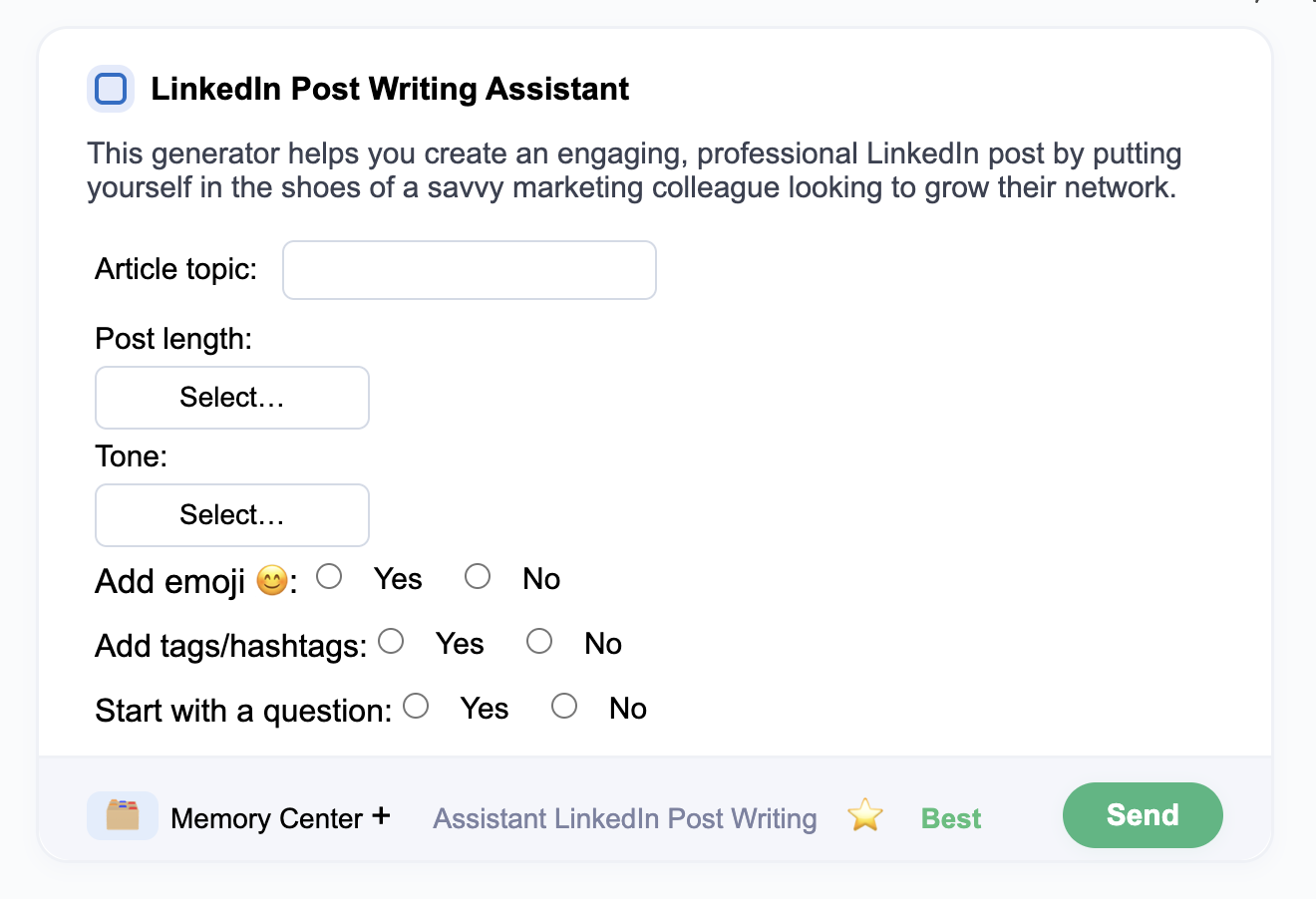
This agent allows you to use the same prompt each time by easily adapting the length, tone, adding emojis, hashtags...
To customize this prompt and create your own AI agents in a few clicks, discover Delos for free.
Conclusion
Writing a good prompt isn't just about knowing how to talk to the AI: it's learning to structure your thinking. By defining your purpose, your Audience, the role of AI and the format expected.
But for a company, the challenge is not limited to the quality of a prompt: it is about secure, centralize and make reliable its use on a large scale.
.jpeg)



Ready to start with Delos?
Start now with a 7-day free trial or ask for personalized support.