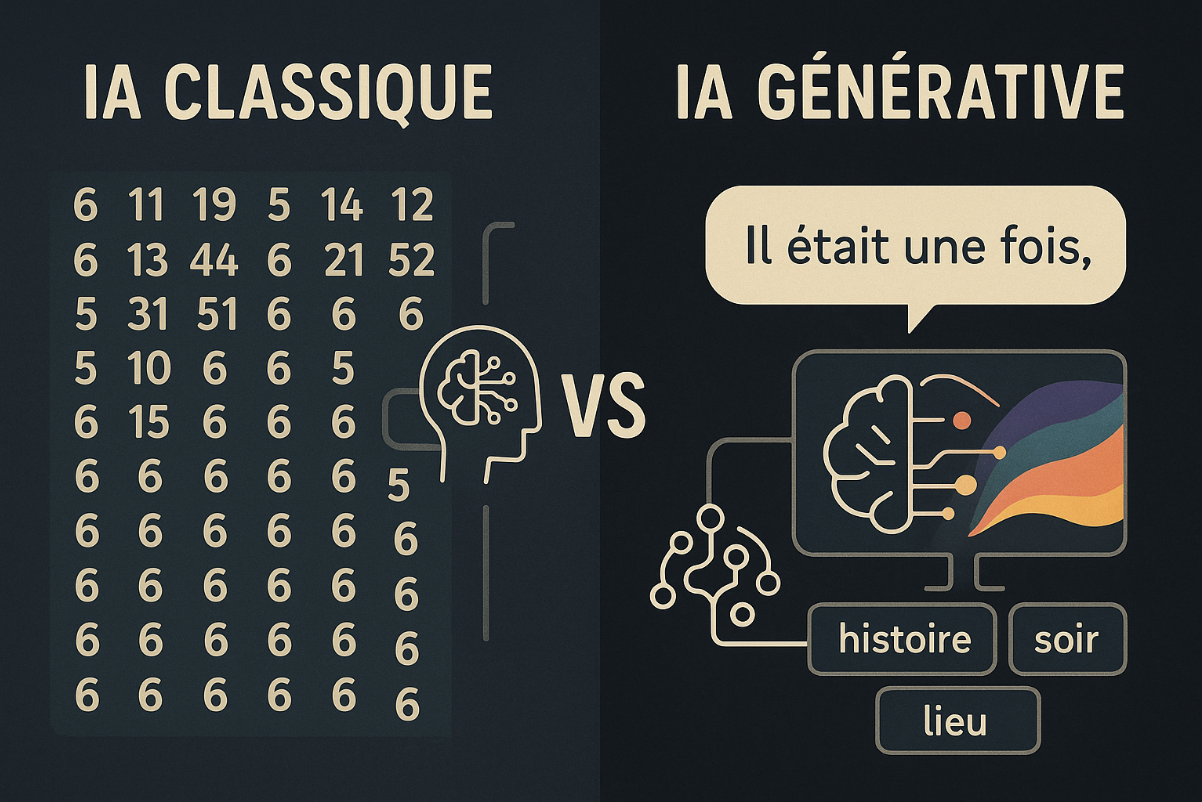
Classic AI vs generative AI: What are the differences?


Before choosing between traditional and generative AI, it is essential to understand how businesses actually approach the adoption of artificial intelligence and what results they are getting from it.
According to the study IBM published in 2024, 26% of large French companies (with more than 1000 employees) say they have actively deployed AI, while An additional 45% are in the exploration or experimentation phase.
At the same time, the report mentions that 75% of businesses Investing in AI projects Did Not Reach the Expected Return on Investment.
These figures show two things: AI is already widely used but a high proportion of companies are not yet able to transform AI investment into real benefits for the company.
Foundations of classical AI: Definition and operation
TEAClassic AI (also called traditional AI or “analytics”) is based on supervised learning algorithms, statistical models, and “classical” neural networks.
In other words, it takes data, identify correlationships, and then predicts or classifies.
For example: In human resources, the algorithm can analyze thousands of resumes to predict the most compatible candidates for a position. AI learns from past data and then predicts. It's fromPredictive AI.
The 3 main categories of AI
- Analytical AI : It allows you to describe what happened. Example: “This quarter, our sales in Europe fell by 8%.”
- Statistical AI : It quantifies relationships between variables. Example: “There is a correlation of 0.7 between the advertising budget and the conversion rate.”
- Predictive AI : It is based on past data to anticipate the future. Example: “This customer is 80% likely to buy in the next 30 days.”
In many classical solutions, we combine the three: we analyze (analytical), we identify patterns (statistical), then we predict (predictive).
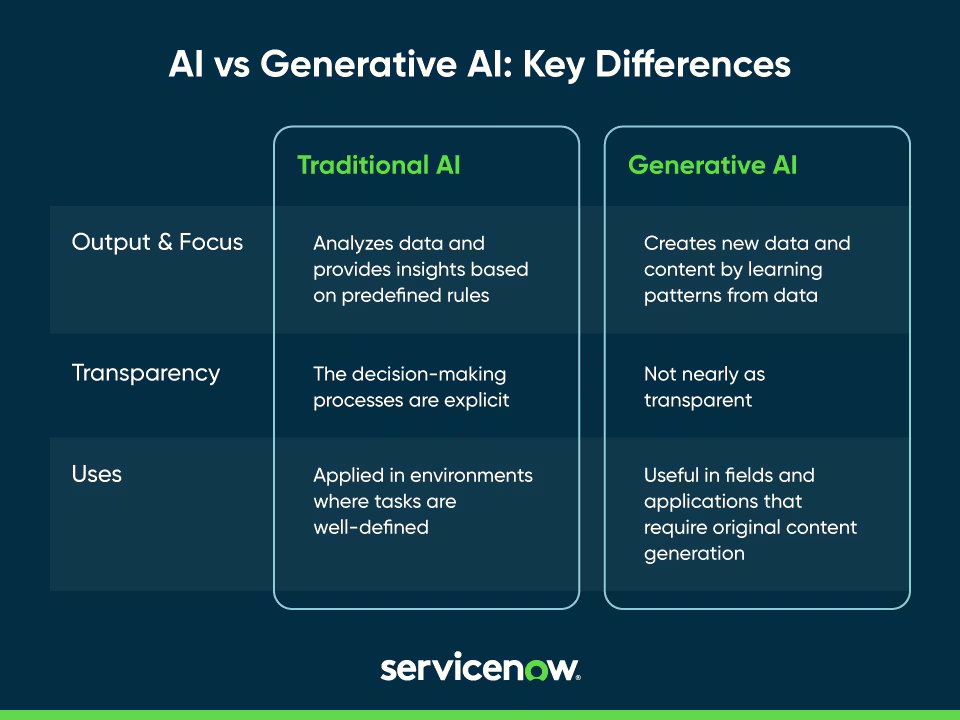
Advantages & limitations
Benefits
- Efficient when the data is Well-Structured (tables, SQL databases, KPIs).
- Robust in stable and well-defined tasks (e.g. fraud detection, scoring, segmentation).
- Transparency: it's easy to determine why the model made such a decision, which is useful for compliance or audits.
Real Limits
- As soon as cases are New or creative, traditional AI systems are becoming much less effective. Example: Classic AI will have a lot of difficulty in imagining an original slogan or designing a new visual because it is based on information that already exists.
- Therefore, it depends largely on the quality of the data (missing data, biases, errors).
Classic AI use cases
- Sales forecast
Example: a retailer uses past sales, seasons, seasons, promotions, weather, to predict how much stock to order. Classic AI (linear models, random forests) acts here. - Fraud detection
Bank example: historical transactions marked fraud vs non-fraud. The model learns to spot anomalous patterns in new transactions. - Logistics Optimization
Example: optimize delivery routes with time, cost and distance constraints, to minimize the total cost.
These cases are well mastered by classical AI because errors can be quantified and the data is well structured.
What is generative AI? Definition, operation and usefulness
Definition and operating principle
TEAGenerative AI uses more advanced architectures (language models like GPT, image streaming, etc.) for Produce original content.
Its operation is based on models trained on huge Data grouping not labelled: text, images, code. It is given “prompts” (requests) and it generates a Response Plausible based on a Statistical Probability : the model chooses the words most likely to follow based on the context provided.
For example, when you type a message on your phone, the keyboard automatically suggests the following words. If you write, “I'm sorry to...” and the system suggests “I didn't respond sooner,” that's a perfect example of the idea. The system has Analyzed Millions of Sentences Similar and Anticipates The most likely continuation of your text. He Doesn't Actually Understand Your Emotion, but he knows, from a point of view Statistical, how users tend to end this type of sentence.
How does this actually apply in a professional context?
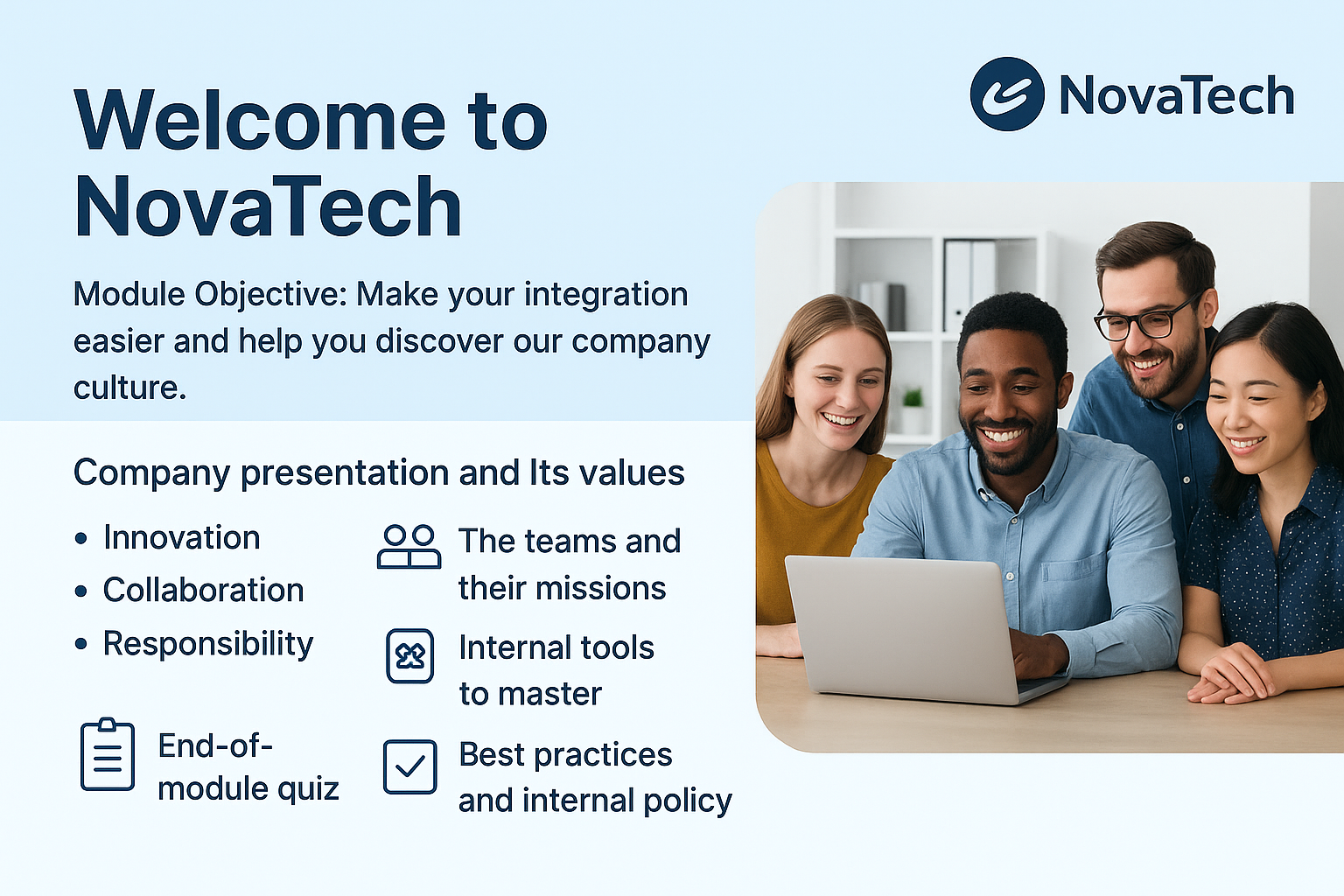
Creation of training materials for an HR manager
Prompt:
“Write an onboarding module for new employees, adapted to our corporate culture.”
Example of an AI-generated visual:
Product design for a designer
Prompt:
“Imagine a futuristic reusable aluminum water bottle.”
Example of an AI-generated visual:

Commercial writing for a marketing manager
Prompt:
“Submit a LinkedIn message to present our new consulting offer.”
Example of an AI-generated visual:
💡 At NovaTech, we believe that performance requires a clear strategy and informed decisions.
That's why we're launching our new consulting offer dedicated to the digital support of businesses.
Our goal: to help organizations identify their growth drivers, optimize their internal processes and take full advantage of technology to gain efficiency.
Whether you are an SME or a large organization, our experts support you at every stage — from audit to operational implementation.
👉 Contact us to find out how we can turn your ambitions into concrete results.
#Conseil #TransformationDigitale #Innovation #Performance
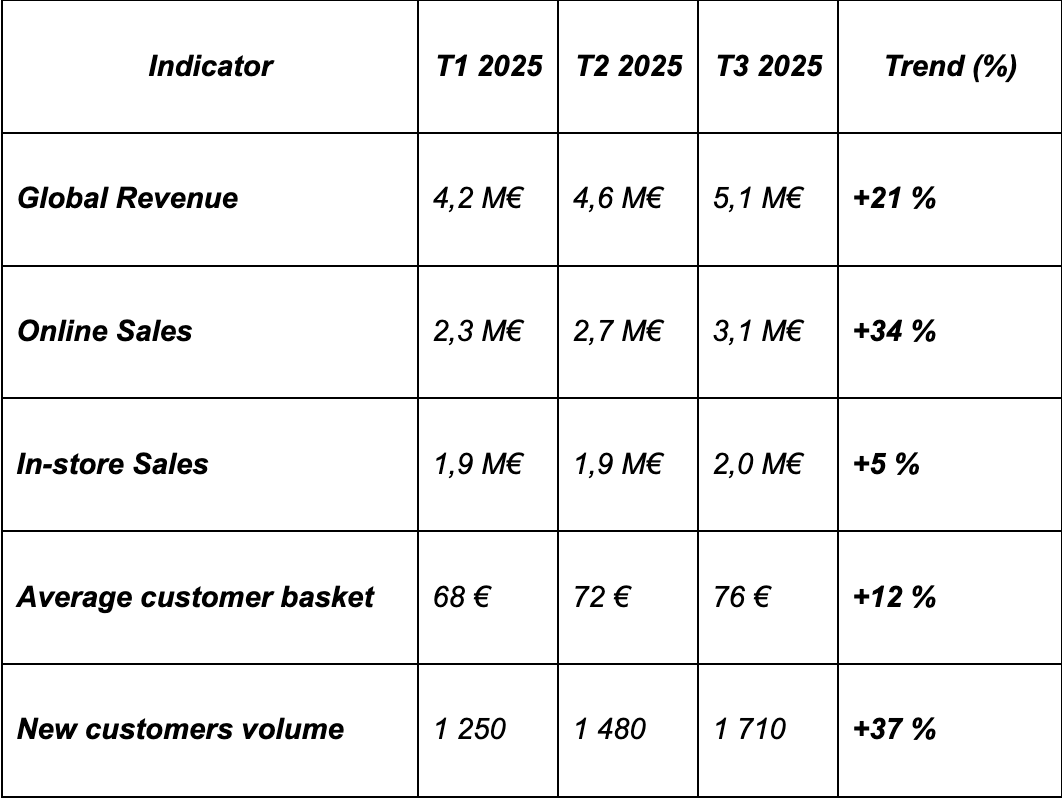
Decision support for an analyst
Prompt:
“Summarize this 30-page report on our quarterly sales.”
Example of an AI-generated visual:
Sales summary — NovaTech
Observed benefits
According to the site Bpifrance, generative AI would allow nearly 60% of employees To save 5 hours of work per week for certain types of content tasks such as writing or web research.
In another survey published by forbes, 86% of businesses having implemented generative AI said they had seen a increase in their income by more than 6%. At the same time, 77% observed an improvement in lead acquisition, and 45% say employee productivity has at least doubled.
Direct comparison: classical AI vs generative AI
Fundamental differences (with example)
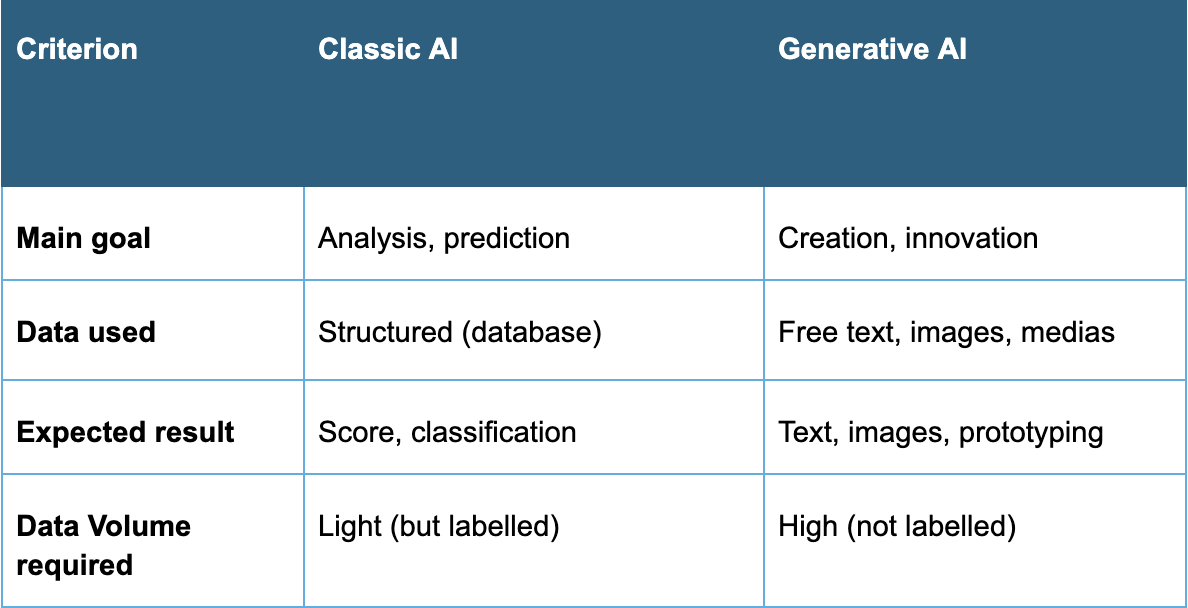
Simple example
Let's say you want to decide on the optimal price for a product: you use a classic AI that looks at past sales, competitors, seasonality, etc., and the AI offers you a price.
If you want create the sales page, the slogan, the visuals, you ask generative AI to generate several proposals.
Complementarity or competition?
Instead of opposing them, the best option may be to combine.
- First, classic AI analyzes your customer data (profile, behaviors, segments).
- Then, generative AI uses these insights to generate personalized content (emails, visuals, scripts).
Criteria for choosing between classical AI or generative AI
Here are some clear criteria to help you choose:
- Main objective
- If your priority is “analyze, predict, optimize,” classical AI is probably enough.
- If you are looking for “create, automate generation, innovate”, generative AI is more suitable.
- Nature of available data
- If you only have structured data (numbers, SQL database), classic AI.
- If you have large texts, images, corpora, generative AI can take advantage.
- Volume of content to be produced
- If you need to produce a lot of similar or personalized content, generative AI becomes the only choice.
- Risk
- For regulated sectors (banking, insurance, health), classical AI with more transparency is often valued.
- Generative AI can pose risks if decisions are not verified by a human and if the tool used is not secure.
Conclusion
Choose between Classic AI and Generative AI is not a binary dilemma, but a question of business priority, context, resources and maturity.
- If you need robust analyses and reliable forecasts on well-structured data, classical AI is often the foundation.
- If you need to produce content at scale, innovate in communication, automate creation, generative AI is preferred.
In most cases, testing generative AI is the easiest to test on a small scale. This allows you to clearly measure the gains (time, revenue, quality), and to be ready to adjust.
If you want to test artificial intelligence in a secure and sovereign framework, solutions like Delos Intelligence allow you to get started quickly, without compromising data confidentiality or tool control. The office suite is designed to be integrated into your daily uses.
.jpeg)


Ready to start with Delos?
Start now with a 7-day free trial or ask for personalized support.