What is GEO and why should we start doing it now?


With 8.5 billion of daily queries on Google, good positioning was once sufficient to ensure a constant flow of prospects and support growth. However, this dynamic is currently changing.
The use of generative AIs and chatbots to search for information is no longer a simple gimmick: it is becoming a professional and general public reflex. According to the “Digital 2026” report by DataRePortal, more than 1 billion people are now using autonomous AI tools every month. In addition, the Gartner report forecasts a 25% drop in Google queries in 2026 in favor of artificial intelligence models.
In addition, hybrid engines combining search and AI, such as Google's “AI Overviews”, have led to a dramatic drop in organic click rates: studies evaluate up to —61% CTR (click rate) on the requests concerned.
Your future client no longer only types “chartered accountant near Lyon” on Google. He asks the question to an AI assistant who answers him directly... without necessarily showing him your site.
This new context should alert any SME manager: even if you already have a solid SEO strategy, your content may no longer be visible at the right times. The research landscape is changing, and to remain visible, you need to adapt to it now.
I. Why are we talking about GEO now?
1. The explosion of AI research: users are no longer looking like they used to
One of the most striking signs of this change is the growth in the use of AI in research paths. According to the report of DataRePortal published in October 2025, tools like ChatGPT, Gemini, Perplexity, and other assistants are becoming the go-to choices for getting quick and comprehensive answers and finding reliable sources.
As this reflex becomes more common, the proportion of traditional searches using manual navigation or keywords is decreasing.
2. Hybrid engines (Search + AI) are changing the rules of visibility
At the same time, the evolution of search engines themselves is accelerating the phenomenon. Google has integrated “AI Overviews” functions that provide AI-generated answers directly on the results page, even before the user clicks on a site.
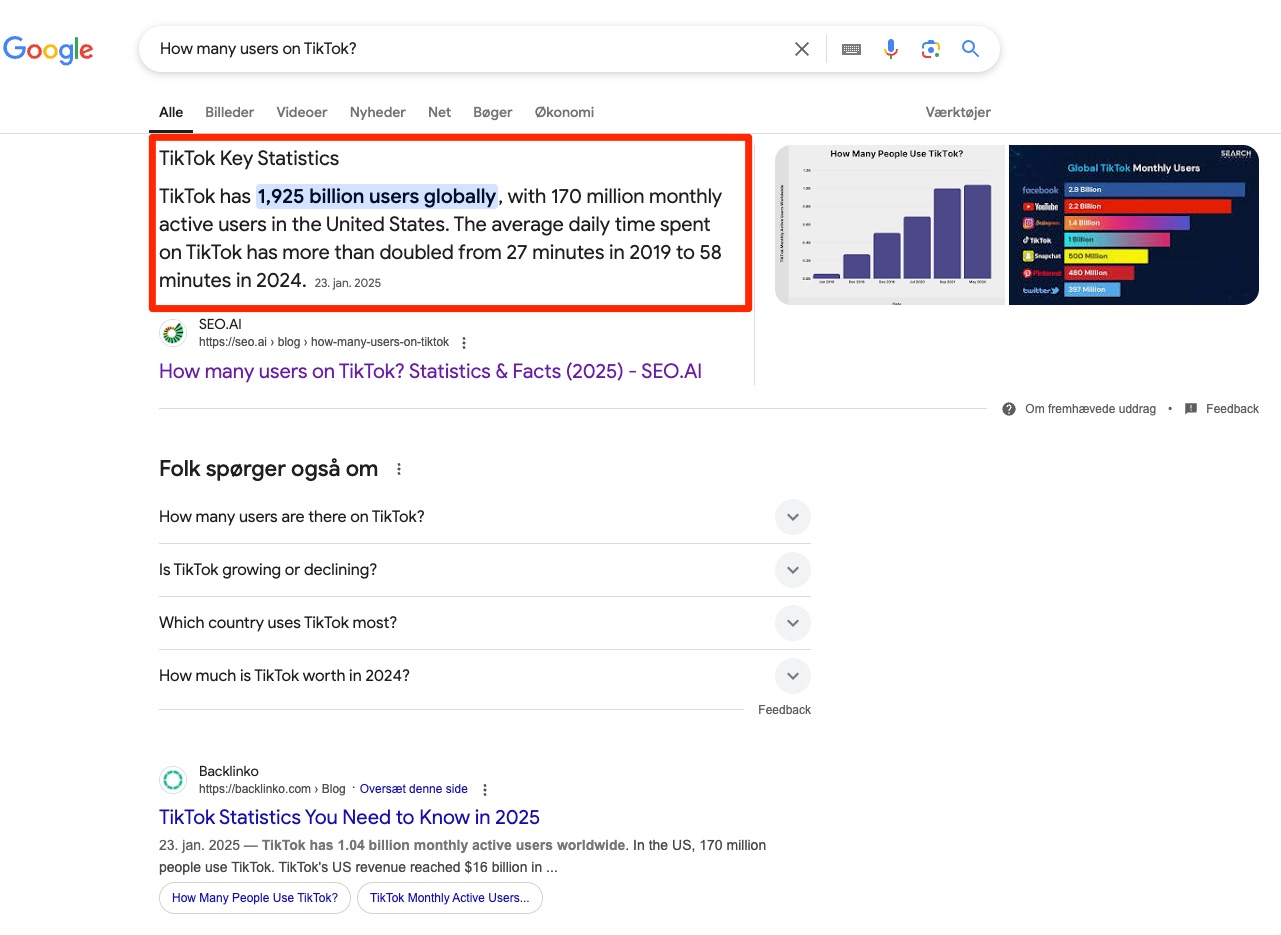
These AI Overviews are a continuation of “Position 0”, whose natural evolution they represent. Where Position 0 was just displaying an excerpt from a web page, AI Overviews now synthesize multiple sources using AI, offering an even more immediate and complete response.
Image of “position 0”:
II. GEO: what exactly is it, and how is it different from SEO?
Research developments have led to the emergence of a new term that is emerging in marketing and tech circles: GEO, for Generative Engine Optimization.
For many managers, this concept seems to be just another variation of traditional SEO. In reality, it's a paradigm shift that directly affects how your future customers discover or don't discover anymore your business.
1. Simple definition of GEO
GEO refers to all practices aimed at optimizing your content for generative AI search engines, like:
- Perplexity AI
- GPT chat
- Google AI Overviews
- Gemini
Unlike traditional SEO, which aims to place you in the results of a list, GEO seeks to ensure that your content is used as a source in the response generated by an AI.
In other words:
SEO aims to standings.
The GEO aims to quote.
Example:
When AI synthesizes an answer to the question: “What financial assistance is available for SMEs?” , the objective of GEO is for your content to be one of the ones it uses to build its response.
2. How do generative engines work? (Why is your content being used or not being used)
To fully understand GEO, you need to understand how an AI search engine decides “who to trust.” Unlike Google Search, which relies heavily on backlinks, site structure, and domain authority, AI assistants use a different, three-step logic.
a) Step 1: Classic search (indexing)
Like Google, AI engines scan the web, but with particular attention to:
- The clarity of content,
- The logical structure,
- The contextual relevance.
An article fuzzy or Too promotional will be less well interpreted by the engine.
b) Step 2: Synthesis by AI
The Language Model (LLM) reformulates and assembles a complete response.
At this stage, it eliminates any content:
- too complicated,
- too long,
- too marketing oriented,
- missing of data factual.
The engine has no interest in using text that does not help enlighten the user.
c) Step 3: Selecting reliable sources
AIs favor content that:
- clearly respond to a Full question,
- contain verifiable figures,
- Cite some reliable third party sources,
- are updated recently,
- adopt a pedagogical structure (definition → numbers → concrete case).
If you want to know more about how AI works, you can consult our dedicated article [How does an AI language model work?].
3. Why does GEO change the logic of SEO?
Classic SEO was built around a simple principle:
If your page is well optimized, Google increases it in the rankings, the user clicks, and you get traffic.
The GEO changes this mechanism, because The user no longer needs to click to get the answer. AI builds it from multiple sources and only 3 to 5 sources are often used.
You can be first on Google... without being used in AI responses.
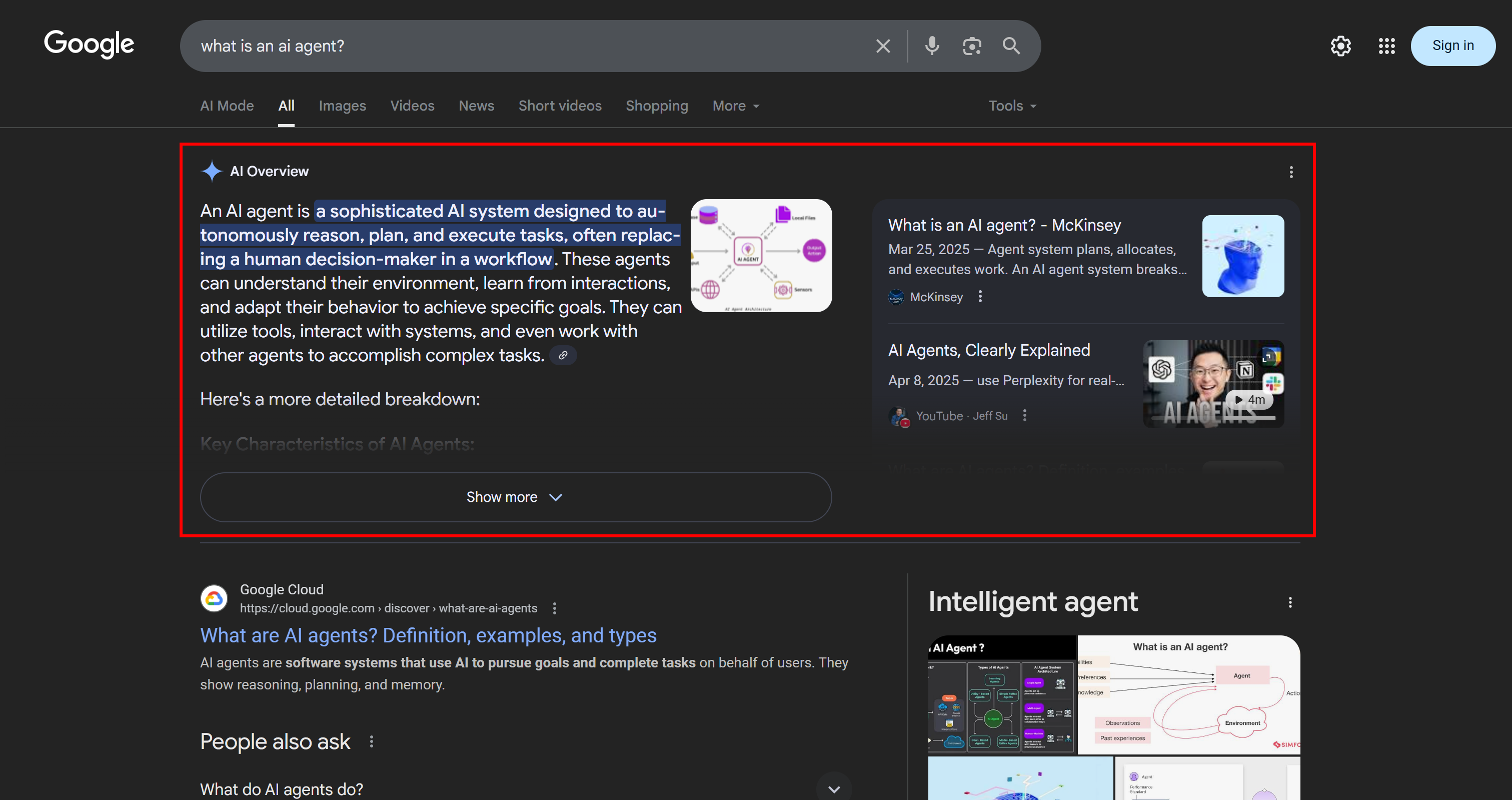
The image shows, in bruise, the response generated by Google AI, supported by springs encircled in unripe. In addition, the first sources from natural referencing (SEO), visible in orange, differ from those used by Google's GEO to create the answer to the question: “What is the difference between GEO and SEO? ”
4. SEO vs GEO: the key differences
Here is a clear summary:

That doesn't mean SEO is going away.
That means that SEO must be complemented by GEO to remain efficient in a world where research is becoming conversational.
III. Why and how to adapt to GEO as soon as possible?
1. Research paths are changing: how can we adapt?
A study conducted by Seer Interactive between 2024 and 2025, reveals a significant impact of the integration of responses generated by AI into search engines: the Click-through rate (CTR) fell by 1.41% to 0.64%
To adapt:
- reformulate key content in the form of explicit questions,
- Give a clear answer right from the start,
- structure information in an educational way.
2. AI engines select according to new criteria: how to produce compatible content?
Generative engines don't favor the same signals as Google Search.
According to google, AIs promote content:
- Clear, with simple definitions,
- structured around questions,
- backed by reliable external data,
- updated,
- solution-oriented rather than promotional.
V. Conclusion
GEO is not just another marketing concept. This is the new field of visibility imposed by the evolution of uses and search engines. In one year, conversational research has transformed the way in which users, individuals and professionals alike, access information.
AI assistants have become entry points, Google now integrates generated responses, and traditional content is no longer enough.
For a company, the challenge is simple: be quoted in AI answers or disappear gradually.
AIs reorganize the hierarchy of sources by valuing:
- the clear contents,
- pedagogical,
- sourced,
- structured in the form of questions,
- updated regularly.
This evolution naturally favors companies that take the time to produce quality, useful content based on reliable data. On the other hand, it strongly penalizes content that is too oriented to traditional SEO or that is too commercial.
.jpeg)



Ready to start with Delos?
Start now with a 7-day free trial or ask for personalized support.